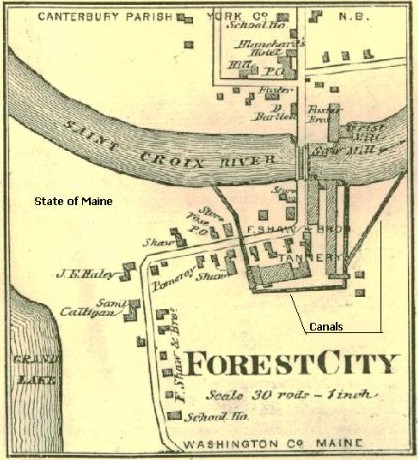
 The image above shows the layout of Forest City, US side, and partial on Canadian side, straddling the international boundary line formed by the river. It is called the St Croix here, but it was always known locally simply as "The Stream".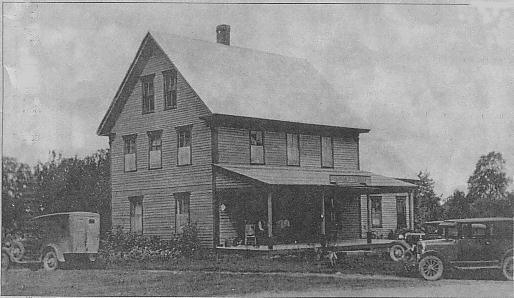
Forest City Hotel run by H Grant c1931. Later purchased by Otto Boone and now owned by Trueman and Betty Parker (2002) See what it looked like around 1900 and 2000. Referred to in the image above as "Blanchard's Hotel" May also been a "boarding house" as mentioned above
Although lumbering was the center of Forest City's industrial strength, the village also boasted a tannery, gristmill, lumber mill, spool mill, blacksmith shop,livery stable and hotel, as well as numerous stores. A dam located where the present day bridge crosses the river, created a backwater where each spring logs were held pending further movement towards St. Croix. As soon as the ice left the Chipineticook Lakes the spring drive began. During the winter, thousands of feet of logs were cut and moved to the lake shores. Around the early part of May each year, booms would be constructed and then towed the length of Grand Lake to Forest City.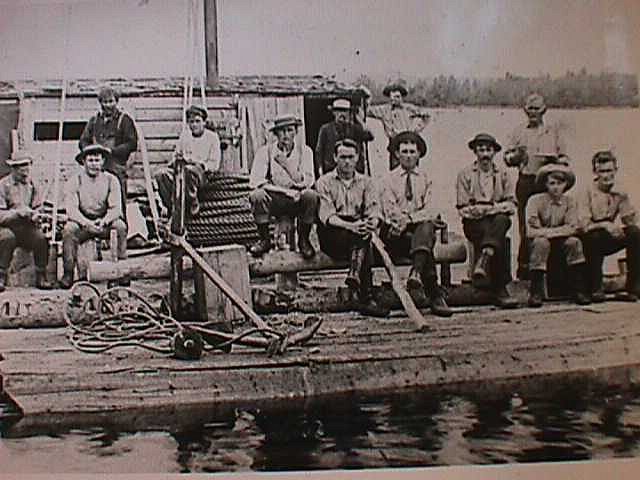
This is the "headworks" and the crew that moved the logs the length of Grand Lake. The big anchor would be taken by boat as far as the rope (wound round the post) would allow, usually about 150 feet, then dropped overboard. The crew would wind the rope up drawing the raft forward as well as the boom of logs behing it. This would be repeated for hours and days on end until they reach their destination. The shack is the cook house. This picture was taken at Forest City, probably around 1900, on the turn just below where the present dam is situated
From there they moved downstream through Mud Lake, over Mud Lake Falls to the Basin in Spednic Lake.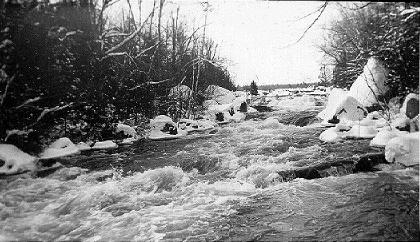
Boats from St. Croix would tow them to the mills at the lower end of
Spednic. Of course, not all lumber made its way down the lake. Much of it remained at
Forest City where the finished product was either used locally or sold to distant markets.
Well into the 1940s and '50s, pulpwood was being trucked to Forest Station, Maine,
where it was loaded into boxcars. Without a doubt everyone who was born and grew up in the
area, at one time or another, worked at cutting logs or pulp. Wages ranged from around
$1.00 per day for a laboring man; around $2.00 for a man with a team. Even in 1957, wages
were only about $5.00 per day including board.
In 1877, F.S Shaw & Bros., operated a tannery on the American side of the stream
where canals, long since dry, supplied water. Directly opposite on the Canadian side where
the present Customs house sits, Foster Bros. operated a saw mill and Grist mill. The
granite grinding stones from this mill can be seen at the entrance to the International
Cemetery, one half mile north. Blanchards run the hotel located on the property now
occupied by the Baptist Church and Truman and Betty Parker. There were two schools, one on
either side of the border. Until the new school was built around 1900 at its present
location (since sold to Jackvaughney who converted it into a summer residence), the old
school was located near the corner of Main Street and Mill Road, opposite the present day
residence of Paul Graham. I was told it was moved across the road and converted into a
store, but this has not been verified.
Forest City, New Brunswick obtained its own Post Office in 1909 located in
Blanchard's Hotel and later operated for twenty-five years by Herb Clark, just across
the street. In the mid forties, Vernon and Mildred Patterson kept the P.O. in their house.
Until Vernon bought a ton truck, the mail was delivered about twice a week from Canterbury
by horse and buggy, or sleigh in the winter. Prior to 1909, the only mail service was
handled by a post office on the American side. In 1959, the Canadian Post office closed
with daily delivery from Canterbury to boxes along the route now known as RR #1.
The twin communities boasted two churches: Baptist on the Canadian side and Methodist
on the American side. The following is how Tressie Lewis Thomas remembers the Baptist
Church, its pastors and parsonage.
A Mr. Harrington was pastor before my day. My mother and father were united in marriage by him in 1881; also Mr. and Mrs. George Gould; and, I am sure, there were many others. His American license made it necessary for the ceremonies to be performed "across the bridge."1944 - 48 or so, John Boone, son of Alex Boone, served the pastorate which by now included the churches at Green Mountain, Fosterville and Eel River. He was replaced by Eldon Coldwell in 1949. Eldon, married to Nellie McLean of Hartland, traveled on a bicycle during his first year, but before he left, he was driving a new chev ½ ton. Ted Calder served in the early fifties. He married Marie Graham, daughter of Harold Graham, and eventually left the ministry taking up duties as a Customs Officer in Campobello where he still lives in retirement. After this there were a succession of ministers with longer periods between terms. The population was dwindling to the point where it became something less than a lucrative field of employment for any ambitious young pastor starting out. Finally, in 1995, the church stands vacant, used only occasionally for a special service or community function. It is interesting to note the bell, thought ruined in 1939, is still very much a part of the church and rings every bit a well now as it did a hundred years ago.
I know of no others who were pastors until Thomas McDonald, an interval of quite a few years. I remember him as I was a very small child. The Parsonage was the house across the street from Gould's. Not too long after this the first Canadian Customs officer lived there: a Mr. Lipsett.
P.A.A. Killiam was the next pastor whom I remember. Probably around 1896-1897. He and his bride lived in the American Parsonage, possibly the first to do so. This was our parsonage for many years because the church at that time belonged to the Northern Baptist Convention with its Maine association in Waterville. Eventually it seemed best to join the Canadian Association and the present Parsonage was purchased.
Our old church burned in the Fall of 1936. Services were held in the present Parsonage, which for a time also served as the home of Mr. & Mrs. Gibson of Fredericton. He was there for the early planning for the financing and rebuilding of the present church. "Times were hard," as we say. I remember how pleased Mr. Gibson was when George Inch, although a Methodist when living in Forest City, sent my mother $25 for that purpose.
After Mr. Killiam, there seems to be an interval which I do not remember. A Mr. Rice was at the church for some time, serving Orient also. He did not live at Forest city.
All along the years there were supplies to fill in the interim between resident pastors. Herman Betts, of Hodgdon, Maine, who was attending Colby College, supplied during the summer of 1903 and 1904. Which seems to indicate that we had no pastors during the winter, at times.
Sometime before 1903, Dr. D.D. Bunker came, not as a pastor;he had retired from nearly 40 years of missionary life in Burma. He held services in the church at times, probably as a fill-in between pastors. Mr. Bunker suffered a stroke one Sunday morning in the pulpit; as he fell, his last words were, "Tell it out," a truly missionary sermon. After two or three years he returned and was there when Mr. & Mrs. Lisle, of West Newton, Mass came for a summer pastorate in May, 1905. It was Dr. Bunker who put the church in touch with the Lisles.
During the summer of 1905, a series of meetings called the "Quarterly Meetings" were held in our church. A number of Maine pastors (and wives) belonged to the Maine Association. The Hodgdon pastor made the remark that he intended to take a brand back to his church;a spiritual fire brand. The 1905 Revival had started. There were two baptisms with 10 candidates on Aug 27, 1905, and one two weeks later when at least five were baptized at that time. The Revival strengthened the church; caused it to grow. It became a good field for the Thompson's the next fall.
Mr. & Mrs. Thompson and 3 months old son, Merrill, came in September, 1905, and stayed with us for three years. Mrs. Thompson, an accomplished pianist, became our organist and also gave piano lessons to many of the young people.
Charles McDonald followed soon after, perhaps in the fall of 1909. Simon Wigglind was here just before him. Mr. and Mrs. McDonald, and Mr. Wigglind, came to Forest City after spending some time at the Kenyon Bible School, Spencer, Mass. Mr. McDonald also had training at Oberlin College, and at Wheaton, Ill. Mrs. McDonald, a good speaker, often spoke in the church. There was one baptism, perhaps two, during at least three years they were in Forest City.
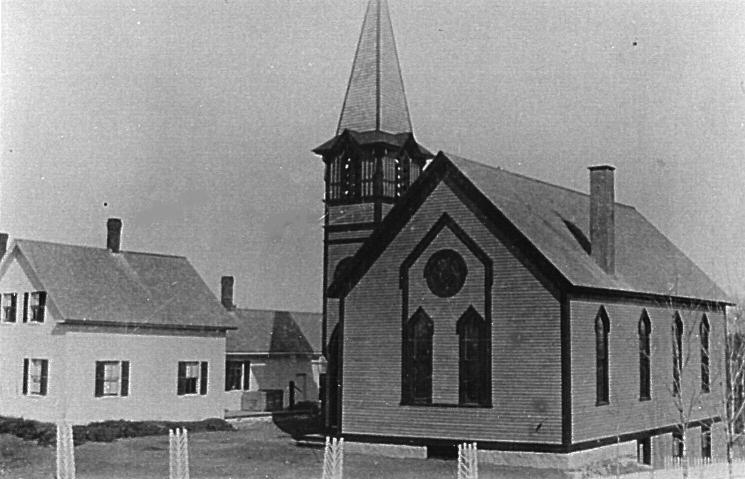
Following the McDonalds, Chester Wood, who was attending Newton Theological Seminary, served the church two summers, one of them being 1914. The second summer he and his sister lived in the American Parsonage and used a motorcycle for transportation. The Methodist Church, Forest City, Maine. Torn down in late 1940
From 1910 onward, I was home only on vacations and not in close touch as in former years. I know that Mr. Barton was our first Canadian pastor and that the change in Parsonages came near this period, as he and his mother lived part of the time in what was once the Inch house, then Stewart Way's. Mr. Barton served the church when I entered Gordon.
In my earliest memory, Henry Houghton, Den Welch, and possibly my grandfather, officiated as Deacons. Very soon after, Mr. Clark and Mr. Gould served during the rest of my connection, and many years after. As I look back I realize how faithful each served; not only ringing the bell on Sunday and Tuesday night, but doing many other chores which surely had to be done, such as building fires, buying wood, oil for lamps. They were always in the pews, filling in when needed. Surely their services will be remembered when rewards are given out.
All through the years there were outstanding workers. One evening a week was set aside for choir rehearsal. In the early years there was a monthly Saturday afternoon Conference meeting. Ladies Aid met on Thursdays, often an all day get-together. There was Sunday School, always a teacher for the boys and girls growing up.
After Ollie and I were able to play at least two hymns, we played in S.S. Later when we were more efficient, we took over the choir. Marjorie did the same. Mrs. Thompson, who came in 1906, was an accomplished musician and was the organist during her three years in Forest City. Little three-year old [in 1909] Merrill, [her son], stood on a chair and sang, helping the choir. the two children still live at Old Orchard Beach, both must be retired by now. Gertrude was a teacher; Merrill, an electrician.Beatrice and Vivian were very faithful help also.
Aunt Anna Blanchard, my mother, Josephine Gould, Uncle Fred Foster, served in the choir for fifty years, at least. Mr. Killiam was an exceptionally good director during his time. I remember the large anthem books, also the smaller ladies quartet. Mrs. Fannie Nye played the organ at the time. Of course, there were others from time to time, but these four, like the two deacons, were always there.
I must have been very small when Marcia Caligan played. The Caligans lived in the house occupied by Marjorie and Herb for some years. Fannie Nye lived in the little house above the American school house. The Nyes moved to Island Falls. One grandson was superintendent of schools in Houlton and later lived here. Another grandson, Ted Robinson, still comes here (St. Petersburg, FL) winters.
Before my grandfather, W.O. Foster, remarried in 1907 or 1908, the present Parsonage was owned by Charles Vantassel, the grandfather of Alton Pray. Alton was also the grandson of Mrs. Pray Foster. My grandfather died in January, 1918 or 1919. His widow lived there for a number of years before she when to live with her son, Frank Pray, in Newport, Maine. They sold it to the church.
Although the Parsonage was my grandfather's home, to me my grandparent's home was the house now owned by Hamilton's. It was painted a dull yellow with brown trim and a fence separated it from the Bartlett property, an unpainted house and barn on south side and back, which fronted on Main Street. I remember it as dark with many trees, with the exception of the north-east corner which was resplendent with many flowers, especially perennials. Mrs. Bartlett loved flowers.
On the other side of the back fence, my grandfather's apple orchard, and for many years a "summer house." more like a playhouse for us children. One apple tree bore large, green sweet apples. I always wondered how Santa Claus was able to get exactly that kind of apple I always found in the toe of my Christmas stocking.
My grandfather and his brother (Uncle Sandy) and their wives (who were sisters) came with their children from Hodgdon, Maine soon after the close of the Civil War in 1871. My mother was eleven years old.
My grandmother had a husband, 5 brothers (all she had) and two brothers-in-law in the service. The youngest brother was a great deal younger than the legal age;around 15 years old at the time of enlistment. His name just happened to be "John Quincy Adams."
The (Foster) brothers bought considerable land, building the old saw mill, and living in a long, narrow unpainted house directly below and between my old home and the mill. The two homes were built over 100 years ago, as my mother, who was married in 1881, lived in the new home a few years before marriage. Her sister and husband, George Inch, lived upstairs in Uncle Sandy's house. I know their marriage was within six months of mother and father's , so that house;the Clark house;is also over a 100 years old. Uncle Sandy died from the after effects of the War at age 44. Aunt Lizzie will still be remembered by some of the older residents.
A notable landmark burned in 1902: the large two storey store just across the canal on the American side of the river, owned by George Inch, a temperance outspoken man; very much against the liquor traffic in the county and in Forest City. The burning of the store had its desired effect. In 1904, he moved his family to Wytopitlock, buying another store and home.We lost one of our outstanding men. He was a pillar of the Methodist Church, but living on the Canadian side, interested in the schools and other village activities. To continue on from where Tressie left off, we find about 1930 or 1931, Walter Ramsey served the field for about three years, leaving in late 1933. Various speakers came to provide services on an irregular basis for a period, including Rev. Cecil Grant from Danforth.
On July 16, 1939, Rev Stott, Pastor in Forest City, and Rev Thomas Brindley of Court Street Baptist Church, Houlton, held dedication services to mark the opening of the new Baptist church built during 1938 as result of fire in 1936. According to an item in the Daily Gleaner "the interior has been newly painted, the pews repaired and varnished, with the addition of new racks for hymn books, new carpeting has been laid on platform and aisles, the yard graveled and the big bell, which fell from the steeple when the old church burned Aug 2, 1936, and was considered perhaps ruined, was repainted and set in place in the new belfry. The church was beautifully decorated with flowers and potted plants, and the services greatly enjoyed by the large audience present."
I have done very little research into the school system and have no particular knowledge beyond my own days there. However, Susan O'Connor, of Pemberton Ridge, provided me with a list of students during 1899 and 1900, indicating John O. Pray was the teacher for the term ending Dec 31, 1899. John, of Forest City, Maine, was a Class I teacher at an annual salary of $225, with ten years experience. From Jan 8, 1900 to Jun 20, 1900, Frank Pray took over and had forty students ranging in age from 5 years to 17 years. Trustees at the time were: George Inch, George Boone and George Gould.
| Student | Age | Student | Age |
| Forest Hartin | 9 | Laura Selvage | 12 |
| Tressa Lewis | 10 | Ina Hartin | 13 |
| May hall | 11 | Addie White | 14 |
| Jessie Boone | 12 | Hazin Hall | 14 |
| Harry Boone | 10 | Mary White | 8 |
| Ollie Gould | 8 | Addie Gould | 8 |
| Frank Boone | 8 | Lena Cosman | 11 |
| William Boone | 14 | Beatrice Gould | 13 |
| Clarence Inch | 17 | Lucy Veysey | 14 |
| Basil W Boone | 6 | Helen Pray | 6 |
| Russell Hall | 9 | Mary Hall | 6 |
| Marjorie Gould | 5 | Eva Vantassell | 12 |
| Alice Inch | 11 | Gladys Grant | 6 |
| Tyson Veysey | 6 | Christina Boone | 6 |
| Maudie Cosman 10 | |||
It was around this time that the school, now a private summer home, was built in its present location. A huge building easily able to accommodate 40 students, it rested on massive square granite blocks providing a crawl space beneath. It had one large class room, two entry ways, a small room between them that served as a library, and a wood shed attached to the rear.
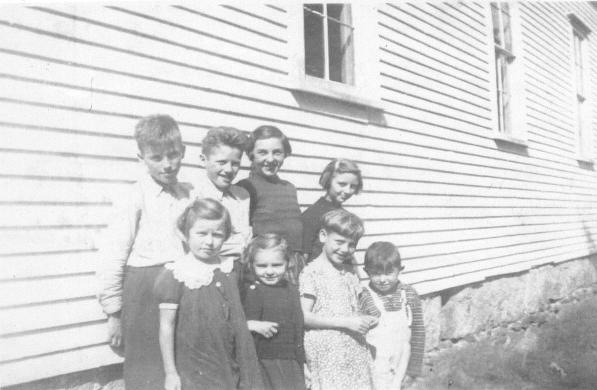
Back row L-R: Stott, Stott, Nadine Patterson, Jean Gillispie
Front row L-R: Winona Graham, Marilyn Patterson, Stott, Paul Graham. Photo c1940
By the time I attended school here beginning in January, 1943, the class had dwindled to only a dozen or so. Bacelia Patterson taught around this time. Nora Veysey taught in 1947 and Gladys Graham did the job in 1948. Margaurite Wetmore and Audrey Jarvis somewhere around this time also. Bertha Higgs took over around 1950 and saw the end of classes above grade 6. From January, 1951, Grade seven students and above attended the new Regional High School in Canterbury. The age of bus travel had arrived. About ten years later, in the early to mid sixties, a new school was built in Fosterville which consolidated the old schools of Forest City, Pemberton Ridge, Green Mountain and North Lake. And it closed its doors in the eighties.
Students I attended school with included: Paul Graham, Winona Graham, Charles Graham, Betty Graham, Connie Graham, Mary Lou Patterson, Arlene Walls, Billy Petit, Donnie Watson, George Watson, Marie Coldwell and probably some others that I cannot remember.